Demo analysis
CS2 Stats Explained: K/D, ADR, HS%, KAST, Rating
A plain-language glossary of CS2 stats — K/D, ADR, HS%, KAST and HLTV Rating — with benchmarks and where each one appears in GetReplay.
Updated September 10, 2026
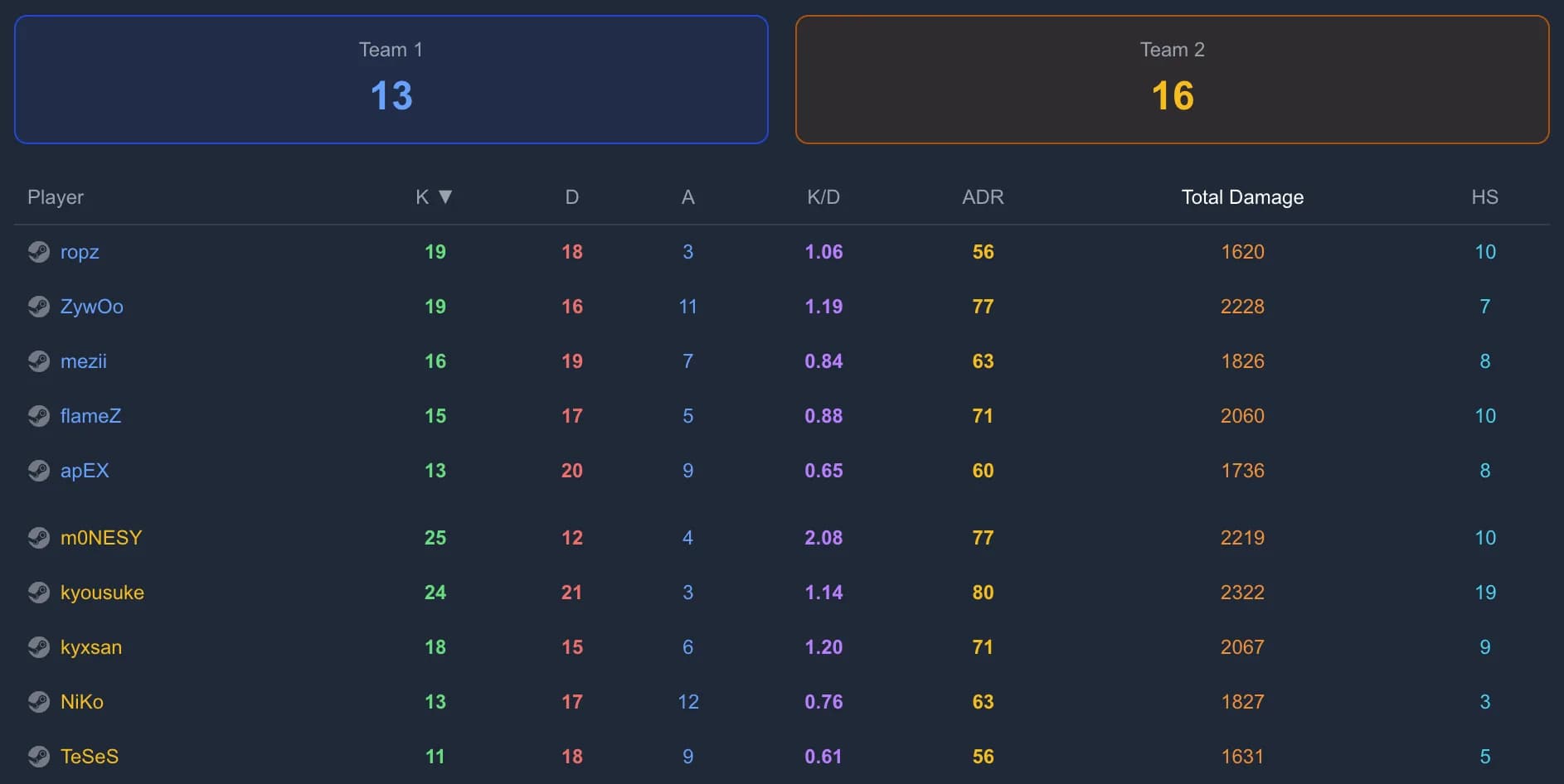
Every CS2 scoreboard and stats tracker throws abbreviations at you — K/D, ADR, HS%, KAST, Rating, Swing — but the game never explains them. This guide defines each stat in plain language, tells you what a good value looks like, and shows where each one appears in GetReplay so the numbers actually help you improve.
Quick reference
| Stat | What it means | Rough "good" value |
|---|---|---|
| K/D | Kills divided by deaths | Above 1.0 |
| ADR | Average damage per round | 75–85+ |
| HS% | Share of kills that are headshots | ~45%+ |
| KAST | % of rounds where you got a kill, assist, survived, or were traded | 70–75% |
| Rating | HLTV composite score of overall impact | 1.00 = average pro |
| Swing | How much your actions shift your team's round-win probability | Positive, context-weighted |
| Opening duel | The first kill/death of a round | Win more than you lose |
| Clutch | A 1vN situation you finish alone | Any win is high value |
K/D — kills to deaths
K/D is the simplest stat: total kills divided by total deaths. A K/D of 1.0 means you trade evenly; above 1.0 means you win more fights than you lose.
It's the stat everyone quotes, but it's also the most misleading. K/D says nothing about when your kills happened — an entry fragger who trades aggressively early can carry a modest K/D while doing more for the team than a player who pads kills in lost rounds.
ADR — average damage per round
ADR is total damage dealt divided by rounds played. It rewards consistent output — chip damage, utility damage, and multi-kills all count — which makes it a better skill signal than K/D for most players.
As a rough guide: 75–85 is solid, and 90+ means you're consistently shaping rounds. Because it counts damage even when you don't get the kill, ADR is the number to watch if you set up teammates or throw a lot of utility.
HS% — headshot percentage
HS% is the share of your kills that were headshots. Higher generally means better crosshair placement and aim discipline. Roughly 45%+ is strong, but treat it as context-dependent: heavy AWP or utility play naturally lowers HS%, and that isn't a problem.
KAST — did you contribute this round?
KAST is the percentage of rounds in which you did something useful: got a Kill, an Assist, Survived, or were Traded (a teammate killed the enemy who killed you within a few seconds). It's an HLTV metric built to reward round-by-round contribution rather than raw frags.
A typical professional KAST sits around 70–75%. A high KAST with a low K/D usually means you're a reliable, low-risk player who rarely wastes a round.
HLTV Rating
HLTV Rating is a composite score that blends several stats — kills per round, survival, ADR, KAST, and an impact component for multi-kills and clutches — into one number. It's normalized so that 1.00 represents an average tier-1 professional across a season, which is why a rating near 1.00 is genuinely strong for a normal player, not "average."
HLTV has iterated on the formula (Rating 2.0, and more recently Rating 3.0), so the exact math shifts between versions, but the idea stays the same: how far above or below expectation you performed.
Swing — impact measured by win probability
Swing (Leetify calls it Round Swing) is the newest way to measure impact, and it answers a question K/D and ADR can't: how much did this play actually change your chances of winning the round?
Instead of counting kills, Swing runs a win-probability model for every moment of a round — built from millions of past CS2 rounds — and credits you with the change your actions produced. The model weighs three things:
- Economy — each team's buy sorted into tiers by equipment value;
- Players alive — a 3v3 is a coin flip, a 5v1 is all but decided;
- Side and who died last — CT and T win rates differ by situation.
Because it's context-aware, the same frag can be worth wildly different amounts. A kill that turns a coin-flip round can move win probability by dozens of points; the same kill against a team already sitting on a ~95% win chance is worth only a few. That's the whole point — Swing rewards the kills that actually decide rounds, not the ones that pad a scoreboard.
Credit for each decisive moment is shared, not handed entirely to whoever got the kill. Leetify splits it roughly 35% to the killer, 30% across everyone who dealt damage, 15% for a flash assist, and 20% to a traded teammate — so setup work and trades count too.
Situational stats: opening duels and clutches
Aggregate stats miss the moments that decide rounds. Two situational stats fill that gap:
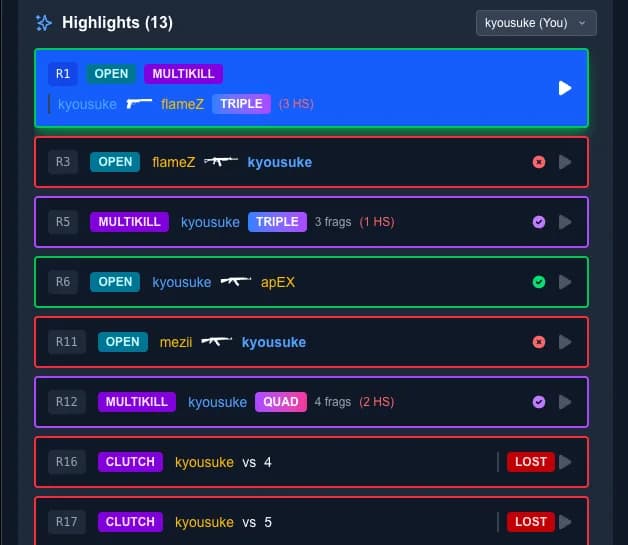
- Opening duel — the first kill or death of a round. Winning openings gives your team a man advantage before the round even develops; losing them repeatedly is a sign to rethink your early positioning.
- Clutch — a 1vN situation you're left to win alone. Clutch win rate reflects composure, game sense, and how well you use time and information.
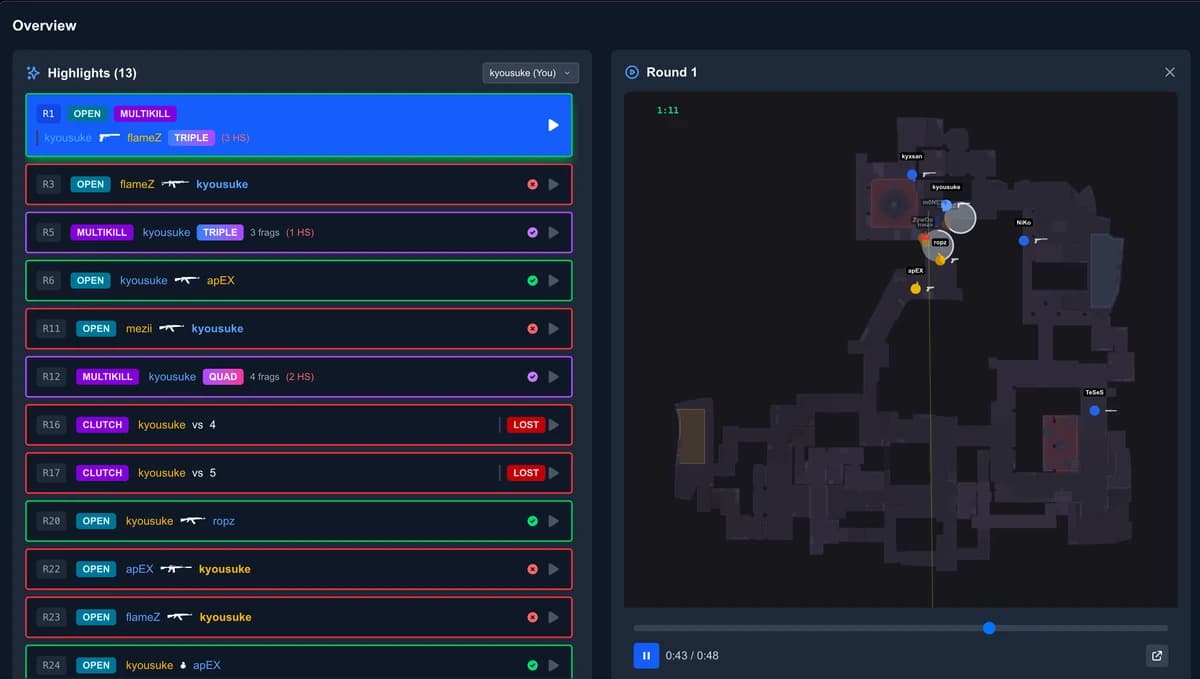
GetReplay detects both automatically from your demo, using game-state analysis (who's alive, bomb status, timing) rather than guesswork.
Where to see these stats in CS2
In-game, the Tab scoreboard shows the basics per match — kills, deaths, assists, and ADR. For everything else you need demo analysis.
GetReplay parses a .dem file tick-by-tick and calculates the full set — K/D, ADR, HS%, opening-duel success, and clutch record — directly from the match, with no third-party API or estimation. Open your own demo in the replay viewer, or see where kills and deaths cluster on the positioning heatmaps.
FAQ
What does ADR mean in CS2? ADR is average damage per round — your total damage divided by rounds played. Around 75–85 is solid; 90+ is strong.
Is K/D or ADR more important? ADR is usually the better skill signal because it credits consistent damage even when you don't get the kill. Use K/D as a quick check, not the whole picture.
How is KAST different from Rating? KAST measures how often you contributed to a round (kill/assist/survive/trade). Rating is a weighted composite of several stats — including KAST — that estimates your overall impact in a single number.
What is Swing in CS2? Swing (or Round Swing) measures how much your actions change your team's chance of winning the round, using a win-probability model that accounts for economy, players alive, and side. It rewards impact in decisive moments rather than raw kills.
Where can I check these stats for my own match?
Open your .dem in GetReplay and it calculates them from the demo — see how to watch a CS2 demo. To see what the numbers look like first, open the example match.