Training
CS2 Terms Explained: 38 Words Players Actually Use
Lurk, execute, anchor, popflash, counter-strafe. The 38 CS2 terms you'll actually hear in a match, grouped by when you need them — and what each should change about your next decision.
Updated August 2, 2026
Counter-Strike has its own language, and the game never teaches it. Someone calls "he's lurking B, don't rotate yet, save if we lose this" — and the round is over before you've decoded it.
This is a working glossary of the 38 terms you'll actually hear in a CS2 match, grouped by when you need them rather than alphabetically. Each entry says what the word means and, more usefully, what it should change about your next decision.
The round and the objective
Site (bombsite)
The areas where Terrorists can plant the bomb — A and B on almost every map. "Site" and "bombsite" mean the same thing.
Callouts about sites are precise, not approximate: "two A" means two enemies on the A site, not somewhere near it. If you pass on vague site info, your teammates make bad rotations off it.
Plant
Putting the C4 down on a site. The plant flips the round completely: the CTs now have to come to you, and a 40-second bomb timer replaces the round timer.
This is why the clock matters more than kills late in a round. Planting with time to spare and a teammate covering an angle beats winning a duel at 0:05 and losing the round to the timer.
Defuse
Cutting the bomb's wires as a CT. It takes 10 seconds bare, or 5 seconds with a defuse kit.
Those two numbers drive most postplant decisions. Half the time is often the difference between defusing under pressure and not being able to start at all — which is why a kit is worth buying even when the round is tight.
Retake
Taking a site back after the bomb has been planted. A retake is a different problem from a defence: you're on a clock, you're usually entering into their crossfires, and you need utility to open the site rather than hold it.
Never retake as individuals arriving one at a time. That is the single most common way to lose a winnable retake.
Postplant
Everything that happens after the plant. On T side it's about holding angles that cover the bomb rather than pushing for more kills; on CT side it's about buying time and information for the retake.
The change in mindset is the whole point: before the plant your job is to take space, after it your job is to spend the clock.
Clutch
Being the last player alive against one or more opponents, and winning — or trying to. Written as 1v1, 1v2, 1v3 and so on.
In a clutch, information beats aggression. Isolate one enemy at a time, use the bomb timer, and remember your teammates can no longer trade for you, so every duel you take must be one you actually choose.
Economy: what your team can afford
Eco
A round where the team deliberately buys little or nothing to afford a full buy next round.
An eco is not a free round to throw away. Saving your pistol, stacking a site, and doing damage all shape the next two rounds — even in a loss.
Force buy
Spending most of the team's money now, accepting a weaker buy, because the round matters more than the savings.
The trade-off is real: win it and you're fine, lose it and you're on eco for two rounds instead of one. It's a team decision, never an individual one.
Full buy
Rifles, armour and utility for everyone. This is the round your practised setups are for.
If your team full-buys and nobody has smokes or flashes, you bought guns, not a full buy. Utility is what turns a gun round into an executable one.
Save
Deliberately keeping your weapon by staying alive when the round is lost. A saved rifle is roughly a full buy's worth of value carried into the next round.
Saving is a judgement call, not cowardice — but saving when the round is still winnable is just leaving a teammate in a 1v2.
Drop
Buying a weapon for a teammate who can't afford one. "Drop me" is a request; the person with money is expected to answer it.
Drops are how a team converts one player's good round into five players with rifles.
Team play and tactics
Default
The standard, low-commitment opening: the team spreads out, takes safe map control, and gathers information before committing anywhere.
A default is not "no plan". It's the plan that keeps every option open until you learn where the CTs actually are.
Execute
A coordinated attack on a site, set up with utility — smokes and flashes on fixed lineups to cut CT vision — with the team entering together right behind it.
The word means the attack itself, not the grenades and not the site. If the utility lands but people trickle in one by one, that's not an execute.
Rush
Committing everyone to one place fast, with little or no utility, betting on speed and surprise.
Rushes beat slow, information-hungry defences and lose badly to a stacked site. Their value comes from being unexpected — a rush you do every round isn't a rush, it's a habit.
Push
Moving forward into contested space. Narrower than a rush: you can push one angle, one corridor, or one player.
Split
Attacking one site from two directions at once, so the defenders can't hold both angles or trade cleanly.
Splits live and die on timing. Two halves arriving five seconds apart is two small attacks getting picked off, not a split.
Fake
Making the enemy believe you're doing something you aren't — throwing utility at A while the team goes B, or starting a defuse just to make the sound.
A fake only works if it costs the enemy something. Utility they don't react to is utility you no longer have for the real hit.
Lurk / lurker
Playing away from your team, quietly, usually to catch rotations or take space behind the defence. The lurker is the player doing it.
A good lurk is timed to the team's noise, not just a player wandering off. The lurker's job is to punish the rotation your team's pressure caused.
Entry fragger
The player who enters a site first to create space for the others. The entry frag or opening kill is the first kill of the round — related, but not the same thing: one is a role, the other is an event.
Entry fraggers are measured by opening duels won and lost, not by K/D. Dying first on purpose, with your team behind you, is doing the job.
Anchor
The CT who holds a site alone or with minimal help, and is expected to survive long enough for rotations to arrive.
The anchor's win condition isn't killing everyone. It's making the attack cost time and utility, then staying alive to retake with help.
Rotate
Moving from one site or area to another in response to information. "Don't rotate yet" means the info isn't good enough to commit.
Rotating on a fake is exactly what the fake was for. Rotating too late loses the site anyway — which is why the quality of a callout matters more than its speed.
Trade / refrag
Killing the enemy who just killed your teammate. Also called a refrag.
Trading is what makes aggression affordable. Two players pushing together turn a lost duel into an even exchange; two players pushing thirty metres apart just die one at a time.
Utility
Utility (nade)
Everything you throw rather than shoot: smokes, flashes, molotovs, HEs and decoys. Also called nades.
Utility is a resource with a round-by-round budget. "We have no utility" is a real reason not to execute.
Smoke
A grenade that creates an 18-second wall of vision-blocking smoke. $300.
Smokes are used to remove angles, not to hide in. The right question is never "where should the smoke land" but "which CT can no longer see me because of it".
Flash
A grenade that blinds anyone looking at it. $200, and the only grenade you can carry two of.
A flash is only worth throwing if someone is moving in behind it. Flashing an empty angle with nobody following is just telling the CT you're coming.
Popflash
A flash thrown so it detonates almost the instant it enters the enemy's view, leaving no time to turn away.
The difference between a flash and a popflash is entirely timing — same grenade, thrown so it pops late. It's the version that actually wins the angle.
Molotov (molly)
Fire on the ground. $400 as the T molotov, $600 as the CT incendiary, and players call both a molly.
Mollies buy time and deny space rather than kill. Their real use is stopping a push, clearing a corner you can't safely peek, and delaying a defuse.
HE grenade
The damage grenade. $300.
An HE rarely kills on its own but sets up everything else — softening a stacked corner or a boosted player so one bullet finishes the job.
Decoy
A grenade that fakes gunfire sounds. $50.
In practice almost nobody reacts to the fake gunfire, so a decoy rarely buys you the information it promises. Its one real use is as a fake flash: throw it out just before you peek and there's a chance the enemy turns away from it.
Lineup
A repeatable throw: stand on a fixed spot, aim at a fixed reference, and the grenade lands the same way every time.
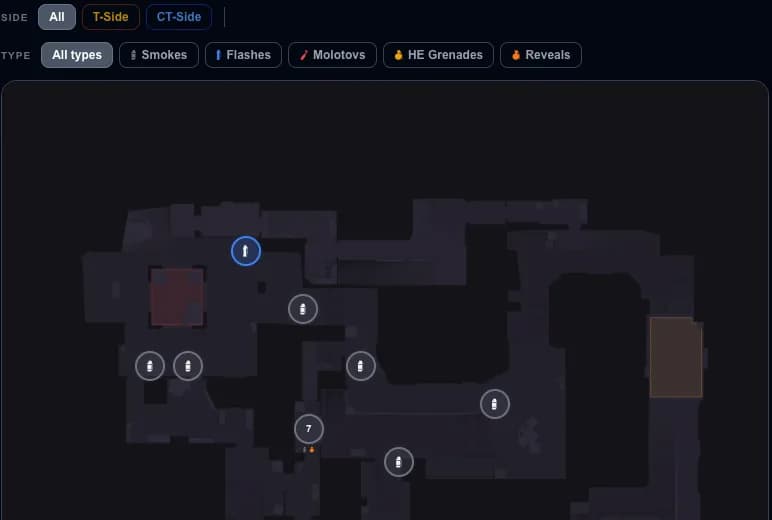
Lineups are what makes an execute possible with a random team — nobody has to improvise the smoke. GetReplay publishes dozens of them per map on the utility pages.
Jumpthrow
Throwing a grenade at the top of a jump, to reach distances a standing throw can't. Many long lineups only work as jumpthrows.
Because the release has to be consistent, most players use a key bind rather than timing it by hand. For practising throws generally, see our guide to repeating your last grenade.
Gunfights and movement
Peek
Stepping out from cover to look at or fight an angle. The variants matter more than the word: a wide peek trades exposure for a better angle, a shoulder peek shows just enough to bait a shot, and a dry peek is one with no flash or smoke supporting it.
Most avoidable deaths are dry peeks into an angle someone was already holding.
Prefire
Shooting at a spot before you see anyone, because you expect an enemy there.
Prefiring is only good when your information is good. Done on a habit rather than a read, it just empties your magazine at a wall.
Crossfire
Two players covering the same space from different directions, so an enemy who turns to fight one is exposed to the other.
Crossfires are why two CTs holding a site from the same corner is far weaker than the same two players holding from opposite ones.
Spray
Holding the trigger down for a long burst. Every weapon's recoil follows a fixed pattern, so a controlled spray means pulling against that pattern rather than resisting it.
Sprays win close fights and lose long ones. At distance, tapping or short bursts beat spraying almost every time.
Counter-strafe
Tapping the opposite movement key to stop instantly, because your bullets are only accurate when you're standing still.
This is the mechanic behind most "I shot first and lost" moments. If you're still sliding when you fire, your first bullet doesn't go where your crosshair is.
Walk (shift)
Moving silently by holding Shift. Sound is information, and walking is how you stop giving it away.
Walking everywhere wastes time you often don't have. Walk in the last few metres before contact, not the whole way there.
Wallbang
Shooting an enemy through a penetrable surface. Rifles and AWPs keep enough damage through common walls to make this a real tactic, not a trick.
Wallbangs punish predictable positions. If you die to the same wallbang twice, the position is the problem, not the bad luck.
Stats terms you'll meet in a demo review
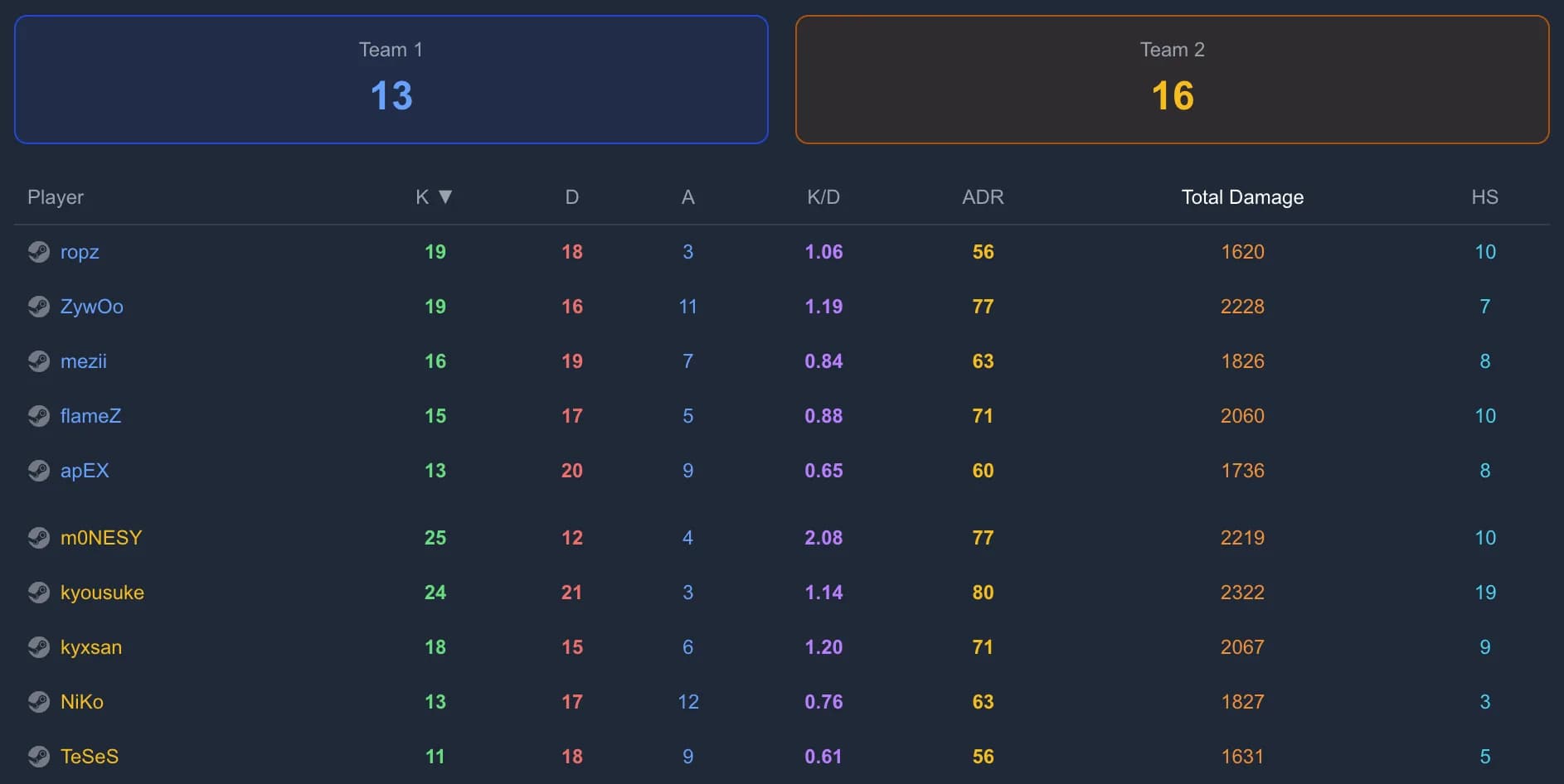
Once you start watching your own demos, a second vocabulary shows up — ADR, KAST, HS%, Rating, opening duels and utility damage. These are measurements rather than comms, and they each have a "good" range worth knowing.
They have their own guide: CS2 stats explained.
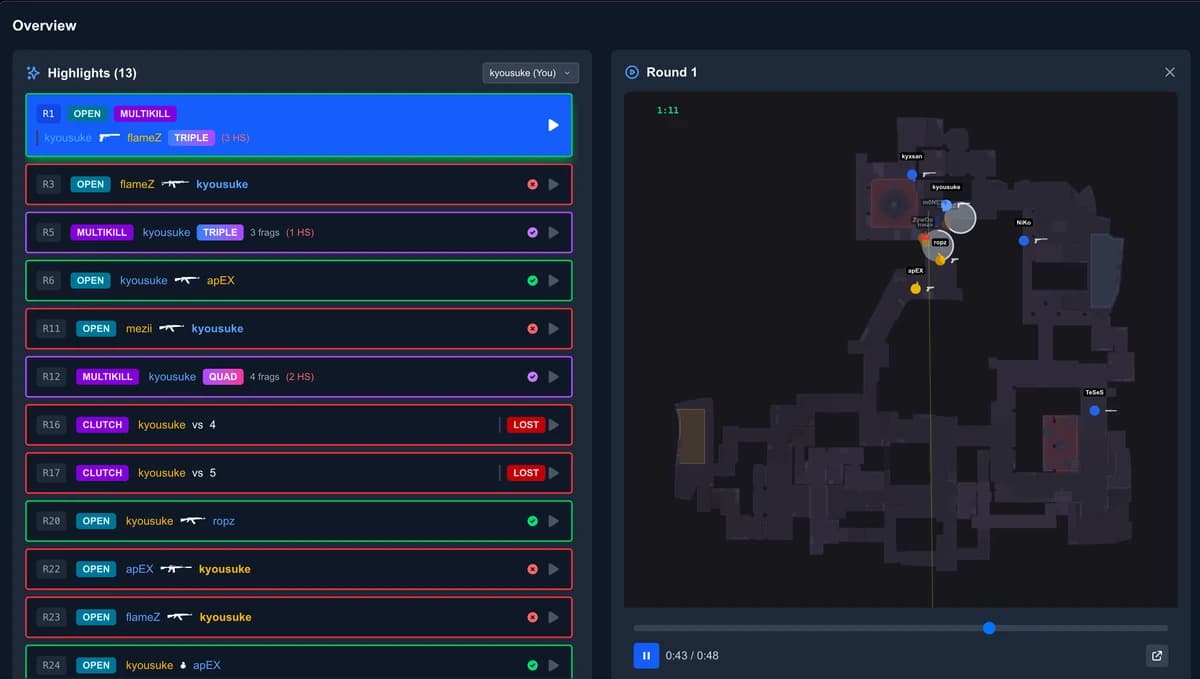
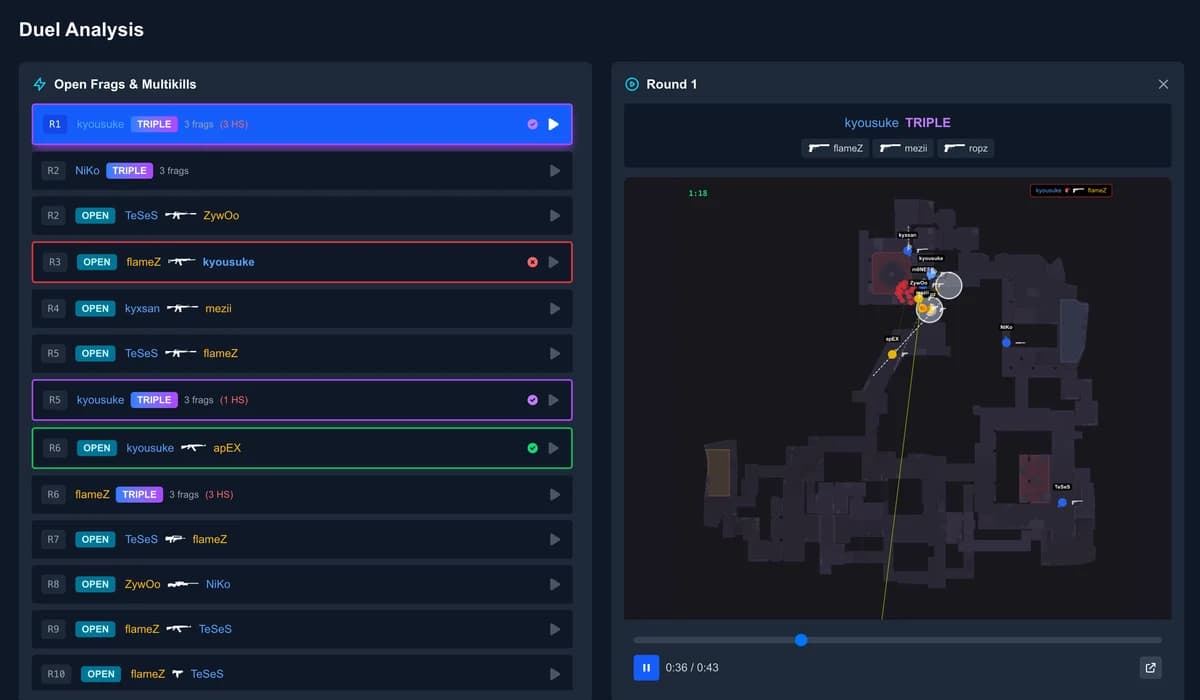
Upload a demo and check a round for yourself: the timeline shows who opened, who clutched, and where the utility landed.