Demo analysis
Why You Should Watch Your Own CS2 Demos (And What You Gain)
What you really see when you re-watch your own CS2 rounds, why reviewing on the same day works best, and a 5-minute routine that fits after every match.
Updated September 27, 2026
You already know how to open a .dem file. The harder question is why you would spend time on a match you have just played — especially one you lost.
Here is the honest answer: the round you remember and the round that happened are two different rounds. Memory keeps the scoreline and quietly rewrites the reasons. The demo keeps everything — where the enemy actually stood, what your teammates were doing, how much time you really had. Most of your improvement is sitting in the gap between those two versions.
What you can't see while you're playing
In a live round you work with one screen and one crosshair. That is a small share of the information that decided the round. You don't see the two players rotating behind you, the teammate who was one second away from trading your death, or the smoke that landed six metres short and opened the angle you died to.
Re-watching your own match is the only way to get the rest of it back. Not to feel bad about the score — to find the two or three decisions that were wrong for a reason you can name out loud.
Review it while you still remember why you did it
Watch the match the same day, ideally in the first minutes after it ends. That single habit does more for you than any checklist.
Right after the game you still have something no demo can store: your intent. You remember that you pushed short because you were sure their AWP was still on B. That you saved instead of forcing because you had counted their buy. That you swung the corner because you expected a teammate right behind you.
Watching the replay while that is still fresh turns review into a comparison instead of a story:
- Was the read correct? The replay shows where that AWP actually was.
- What did you not account for? Usually one player who rotated ten seconds earlier than you assumed.
- What changes next match? Take the same duel again, or hold two seconds for the trade.
A week later the intent is gone and only the outcome is left — and an outcome you can no longer explain teaches you nothing. One match reviewed today is worth more than five reviewed at the weekend.
What you actually see when you re-watch your own rounds
Your deaths, from the outside
Take the deaths that annoyed you and watch each one starting ten seconds before it happened. Almost all of them fall into a short list: you were somewhere your team couldn't trade you, you took a duel with no information, or you stood exactly where you had stood the round before.
That last one is the expensive habit, and it's the one you can't feel from inside your own screen. With both teams visible on the map, a position you keep repeating is obvious immediately.
Clutches you can finally explain
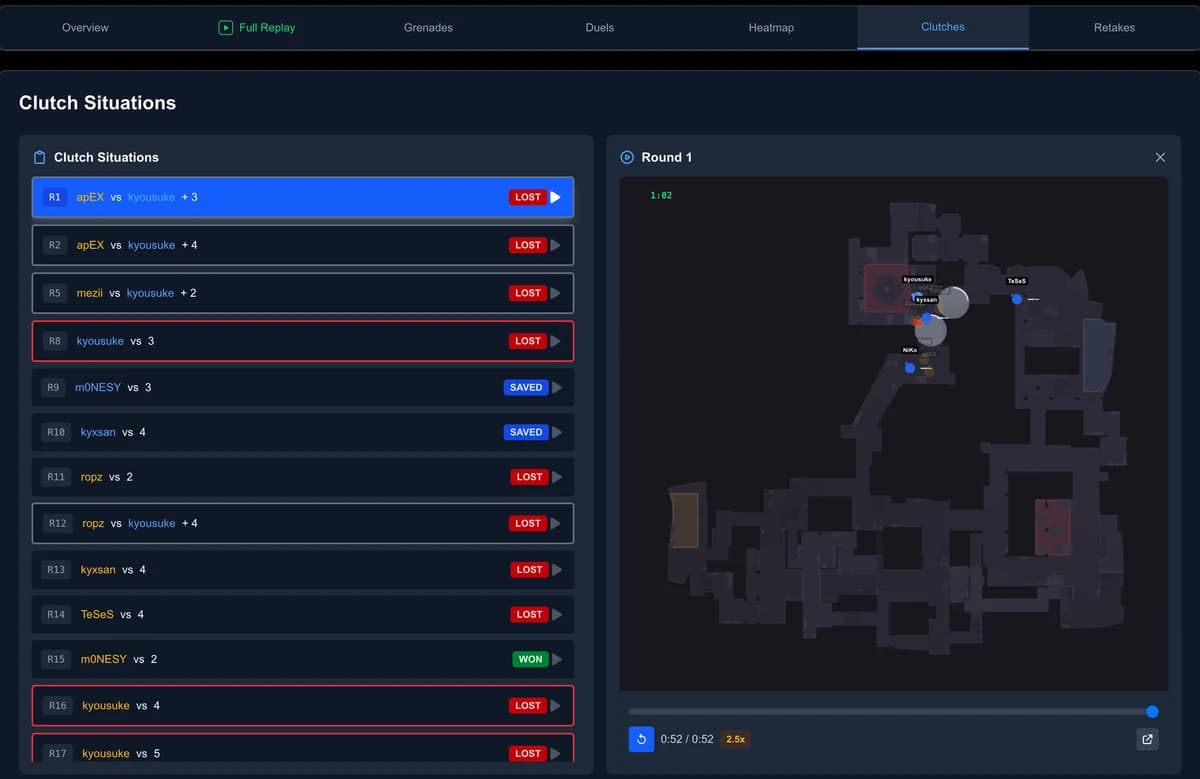
A 1vX is decided by time and information far more than by aim, and both are invisible while your heart rate is at 140. Watched back, you see the actual clock, where the last enemy was when you committed, and whether the bomb forced you to move when you moved.
Do this a few times and clutches stop feeling like luck. You start recognising the same handful of shapes and playing them on purpose.
Retakes: why the site fell apart
Retakes are the clearest team lesson in your own matches, because the mistake is usually shared and nobody notices it live. In a replay it's right there: three players arriving at three different times, everyone entering through the same door, or all the utility spent before anyone was in position to use it.
Where your utility actually landed
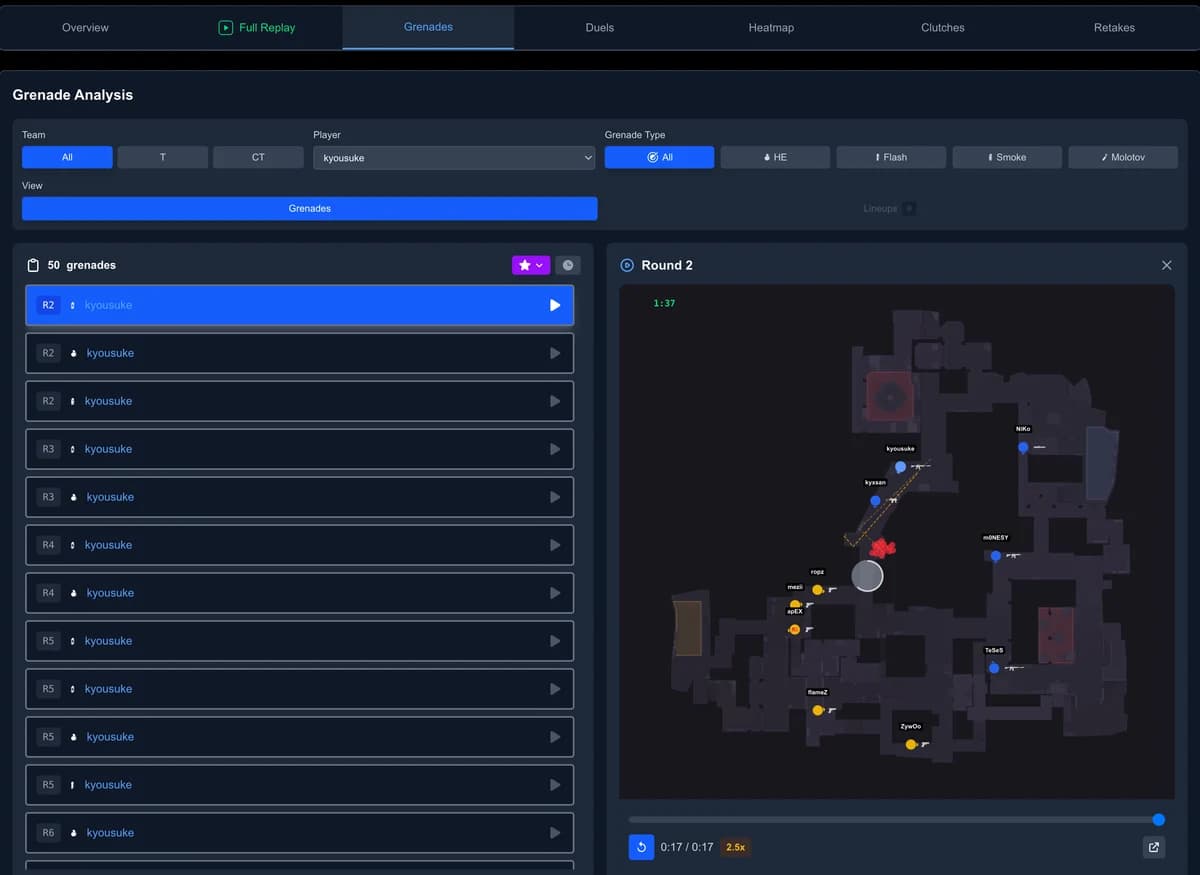
You rarely see your own grenade finish its job — you throw it and then you're busy. In a replay you see where the smoke actually landed, who the flash blinded (your own teammates included), and whether the molotov bought your team those five seconds or none at all.
How the round opened
The first contact shapes everything that follows, but it's worth watching the whole opening rather than the frag on its own. Rewind to the buy and watch both teams move: who was late, which side committed first, and whether you walked into a duel nobody could follow up.
Why most players stop after one demo
Nobody quits demo review because they don't care about improving. They quit because of what it costs:
- launch CS2, find the file, remember
playdemoand thereplays/prefix; - fight
demouianddemo_timescaleto get to the round you actually wanted; - remember
spec_show_xrayand free cam to see anything your own POV missed; - scrub through 40 minutes of match for the four moments that matter;
- and every so often the demo stutters, desyncs, or refuses to play at all after a game update.
Twenty-five minutes of overhead for five minutes of value is not a habit anyone keeps. The fix isn't more discipline — it's making the review cheap.
The same review in a browser 2D replay
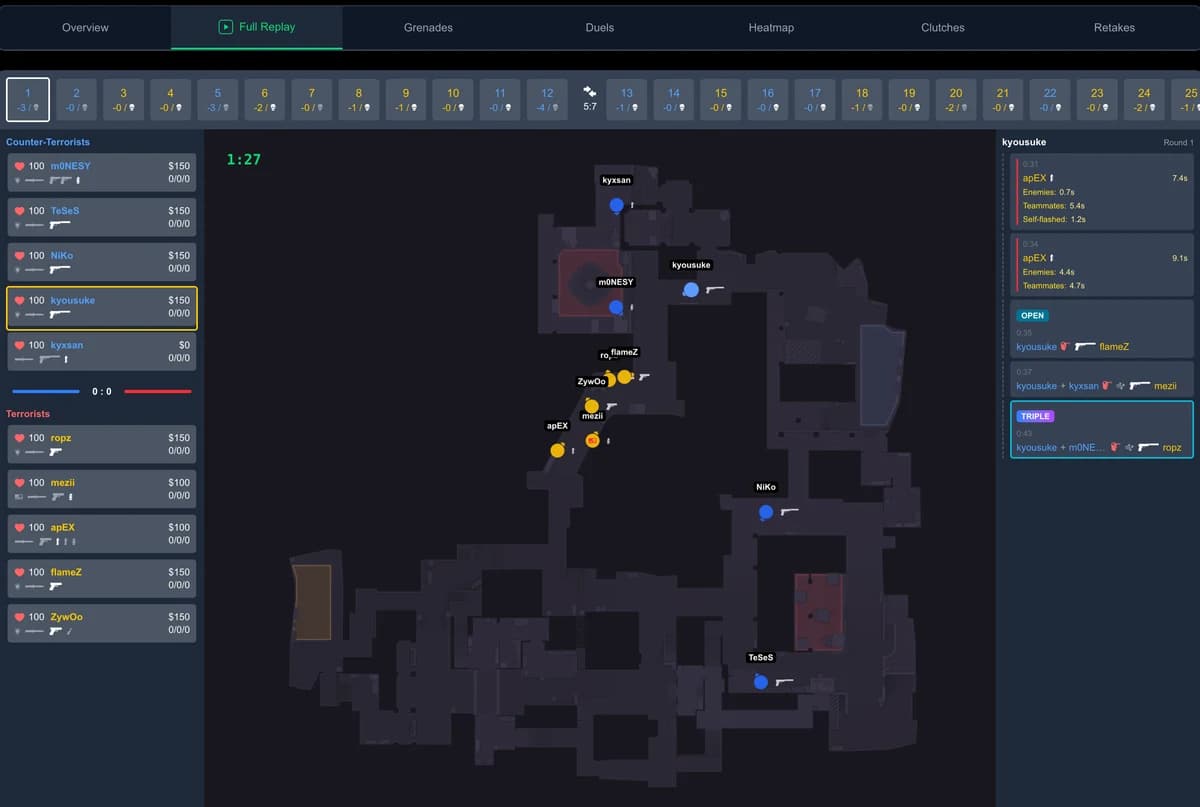
GetReplay opens the same .dem file as a 2D replay in your browser: no game launch, no console commands, and it works on a laptop or a phone. Everything above becomes a click instead of a command.
- Both teams at once. The round plays out on a top-down map, so you're watching ten players, not one point of view.
- Jump straight to the moment. Click any round or event on the timeline instead of typing tick numbers, and Smart Mode skips the dead time between fights, so a 40-minute match takes minutes to get through.
- The key moments are already listed. Clutches, retakes and grenades come as clickable lists — pick the 1v3 you want to understand and watch it, instead of hunting for it.
- Send it instead of describing it. Every moment has a link, which settles a disagreement far faster than your description of what you think happened.
For FACEIT matches, the GetReplay browser extension removes the file juggling: sign in to GetReplay, open or reload the completed match room and click the GetReplay button. GetReplay downloads and processes the available demo on its server, so you do not save it to your computer or upload it yourself. Without the extension, you can still upload a downloaded demo manually.
On desktop, Chrome Web Store extensions can be installed in Chrome, Microsoft Edge, Yandex Browser, Opera, Brave and Vivaldi.
A 5-minute routine after every match
Five minutes, once, straight after the game. This isn't a full breakdown — the goal is one conclusion you can use.
- 0:00–0:30 — open the match and pick the target: the round or the death that still annoys you.
- 0:30–2:30 — watch two deaths, each from ten seconds before it happened. What did you actually know, and could anyone have traded you?
- 2:30–4:00 — watch one decisive round in full: a clutch you lost, or a retake that fell apart.
- 4:00–5:00 — write the conclusion as a single sentence, phrased as an action. "Stop taking mid early on T without a flash" is usable. "Play better" is not.
How to make it stick
- Same day, always. The value of a review drops the moment you forget why you did what you did.
- Mark the round while you're still in it. As long as you're signed in to GetReplay with the Steam account you play on, typing
!gror!getreplayin the CS2 chat during a match saves that round to your bookmarks — with a note, if you add one after the command. Bind it to a key so it costs you nothing mid-round:
- Review the wins too. A round you won on a coin flip teaches you more than a round you lost while playing it correctly.
- One match at a time. A single match after each session, every time, beats a five-match binge you do once and never repeat.
FAQ
Is it worth reviewing demos at a low rank? Yes, and arguably more than at a high one. Low-rank rounds are usually lost to a handful of repeatable mistakes — predictable positions, duels with no information, wasted utility — and those are exactly the things a replay makes obvious.
How long does a useful review take? Five minutes per match if you go in with one target. Long sessions are what make people stop; a short, repeatable review is what actually changes your next game.
Should I watch my own demos or professional ones? Your own, first. Pro demos show you what good Counter-Strike looks like, but only your own matches show what you do under pressure — and that's what you're trying to change.
Do I have to review every match? No. One match after each session, consistently, beats reviewing everything for a week and then never again. Bookmark the rounds worth revisiting while you play and you'll always have a target ready.
Should I watch in CS2 or in a 2D replay? Use the 2D replay for almost everything — it's faster to open, easier to navigate, and shows both teams at once. Open the demo in CS2 when you specifically need to check what was visible from a position. Both routes are covered in how to watch a CS2 demo, and FACEIT matches in how to watch FACEIT demos.